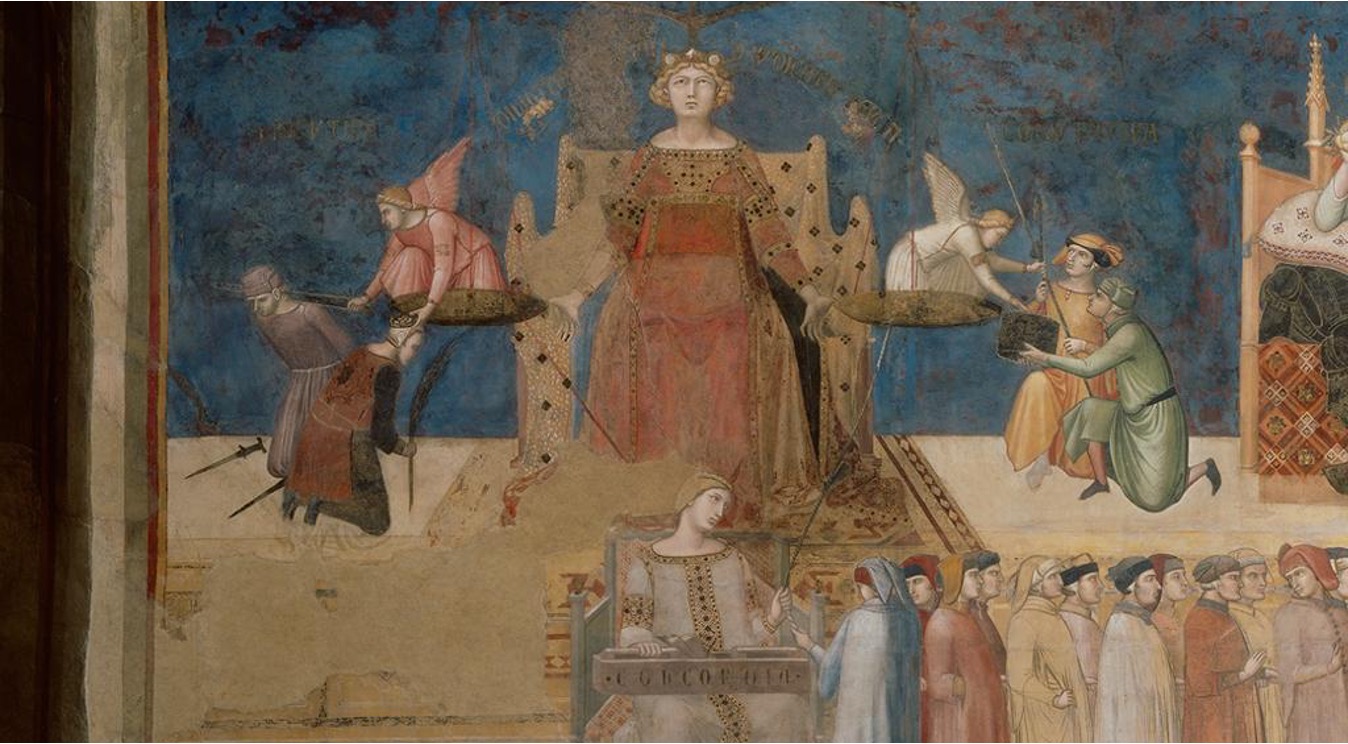
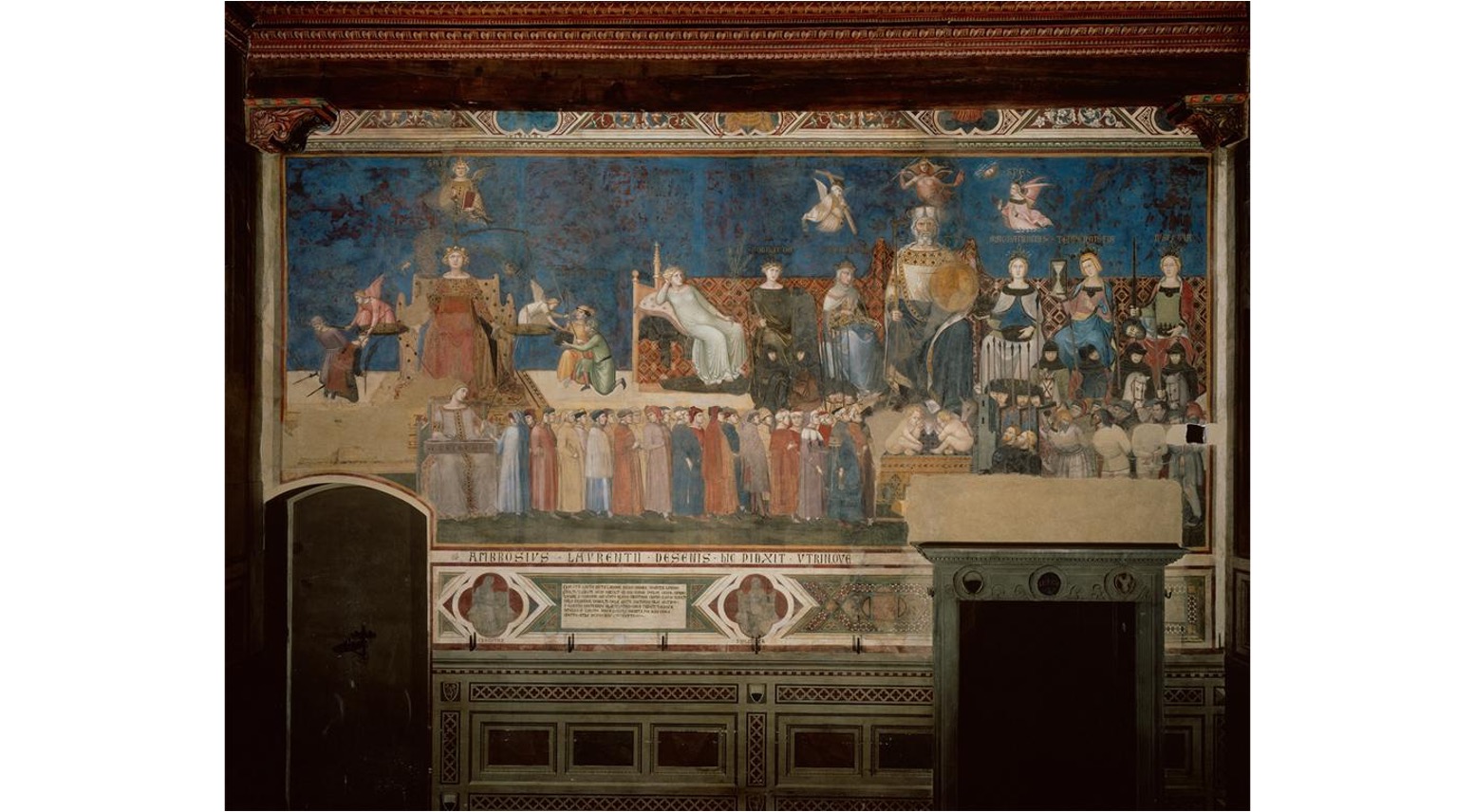
Allegory of Good Government on Town and Country
Fresco
1338-1339
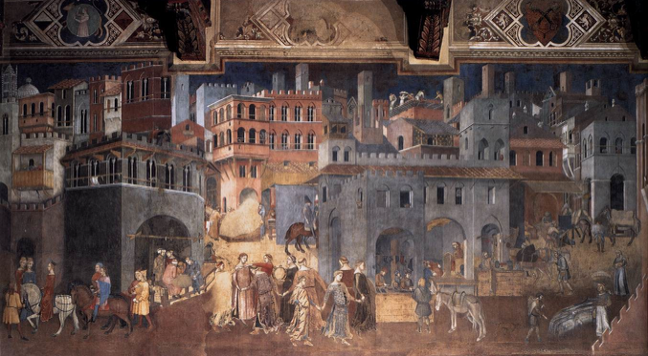
Effects of Good Government on Town and Country
Fresco
1338-1339
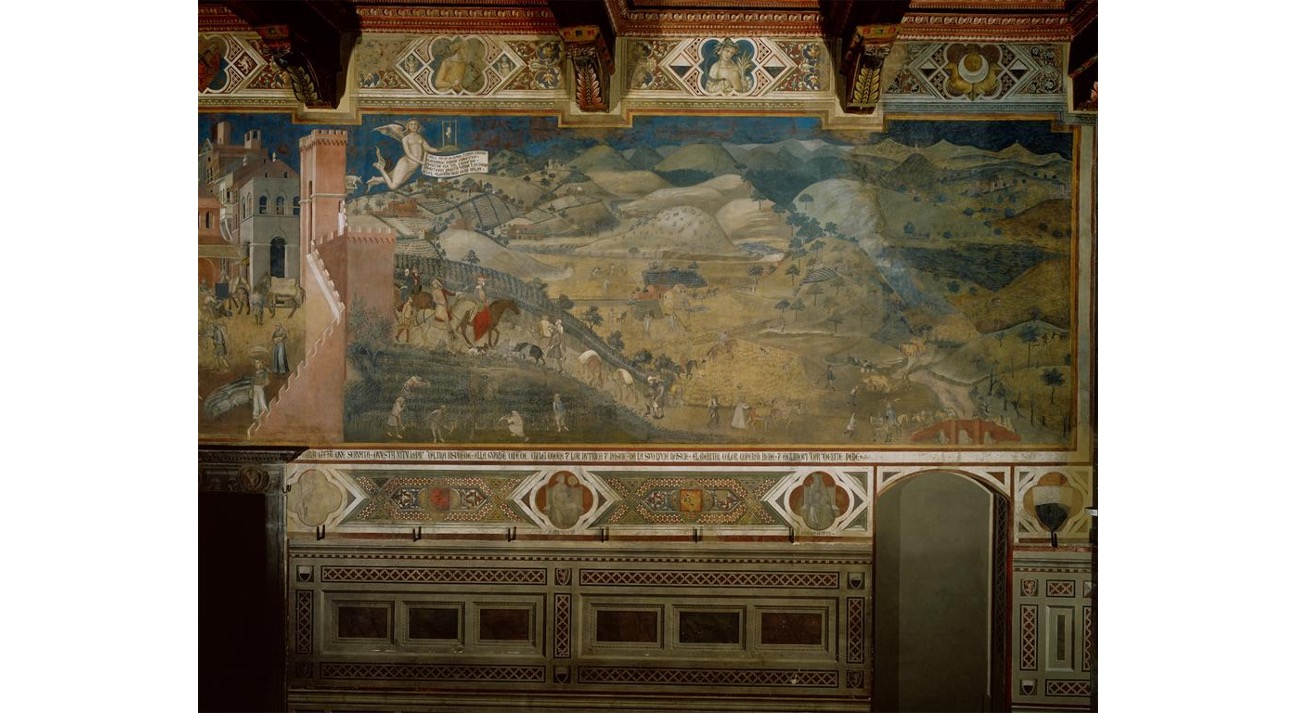
Effects of Good Government on Town and Country
Fresco
1338-1339
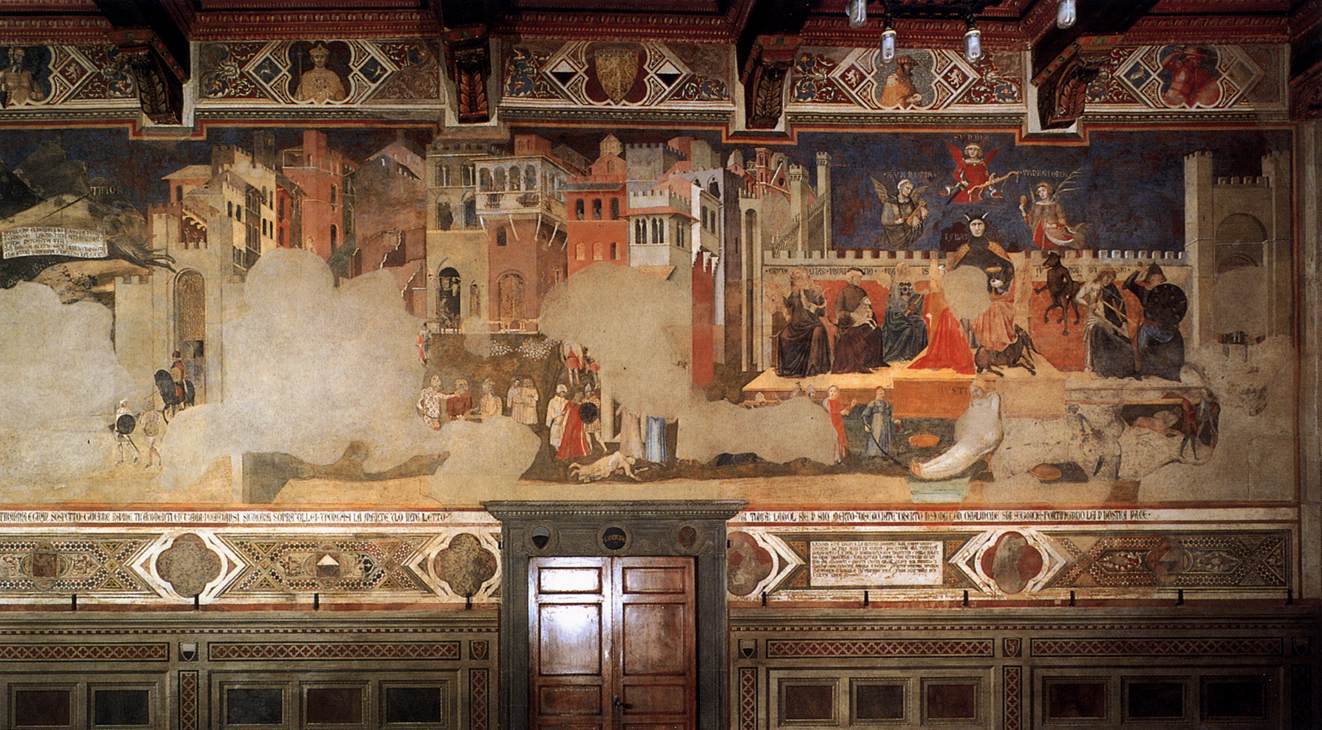
Allegory and Effects of Bad Government on Town and Country
Fresco
1338-1339
Background
Ambrogio Lorenzetti painted these frescoes on a commission in Siena, around the late 1330s. The illustrations adorn the Sala della Pace in the Palazzo Pubblico, where the Nine would meet in order to govern the city. Lorenzetti’s fresco, his most famous work, is especially admired for its depiction of a Well-Governed City, which shows Justice and her supporting virtues. However, for this portfolio I have chosen to focus on the less famous wall, which displays a city fallen prey to Tyranny. Lorenzetti’s work suggests that he was influenced by philosophers and writers such as Aristotle, Thomas Aquinas, Cicero, Seneca, and Dante. In my nontextual creation, I have continued to develop Dante’s influence on the work by writing about the fresco in terza rima.
The Ill-Governed City
or, The Allegory and Effects of Bad Government on Town and Country
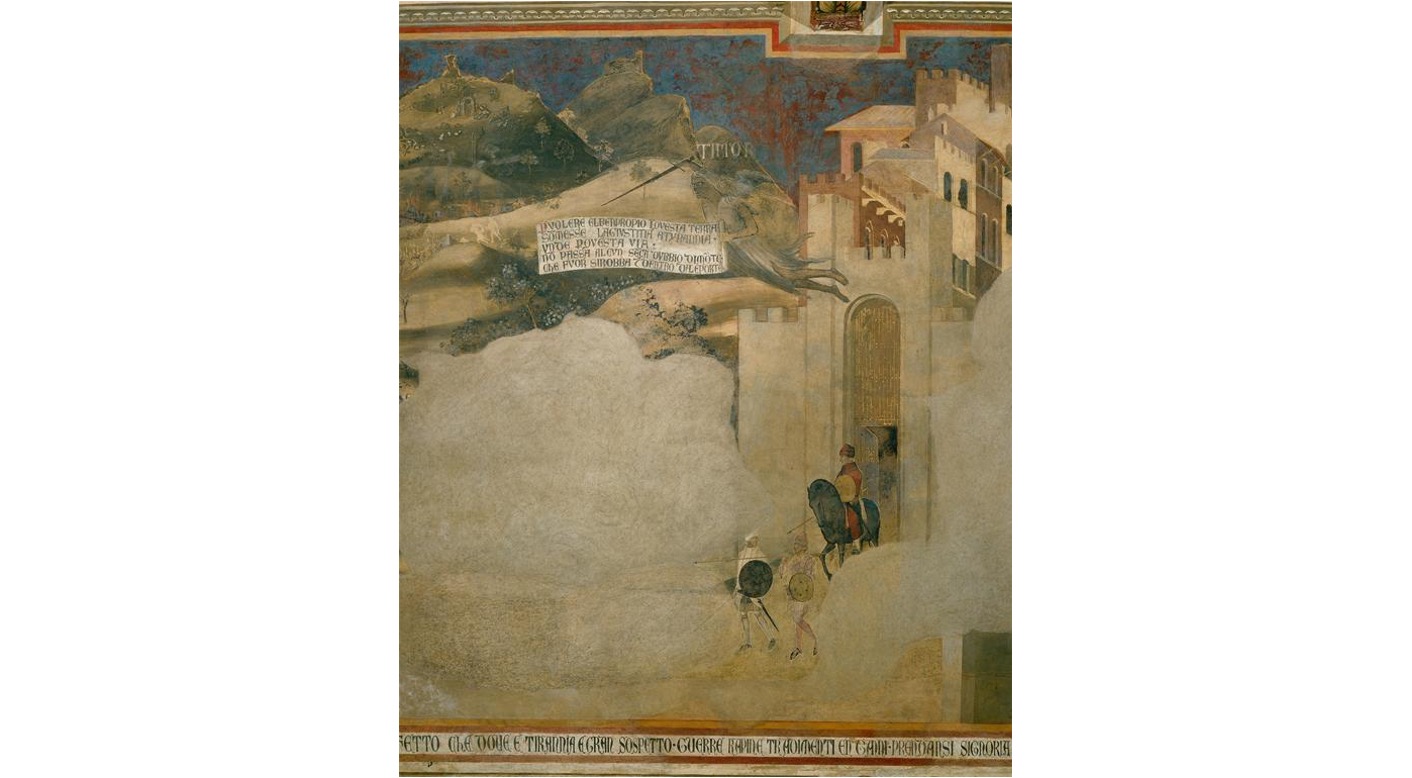
Because each seeks only his own good, in this city,
Justice is subjected to Tyranny;
Wherefore, along this road
Nobody passes without fearing for his life
Since there are robberies outside and inside the city gates.
(Message on the banner carried by Timor).
Midway along a snowy path I found
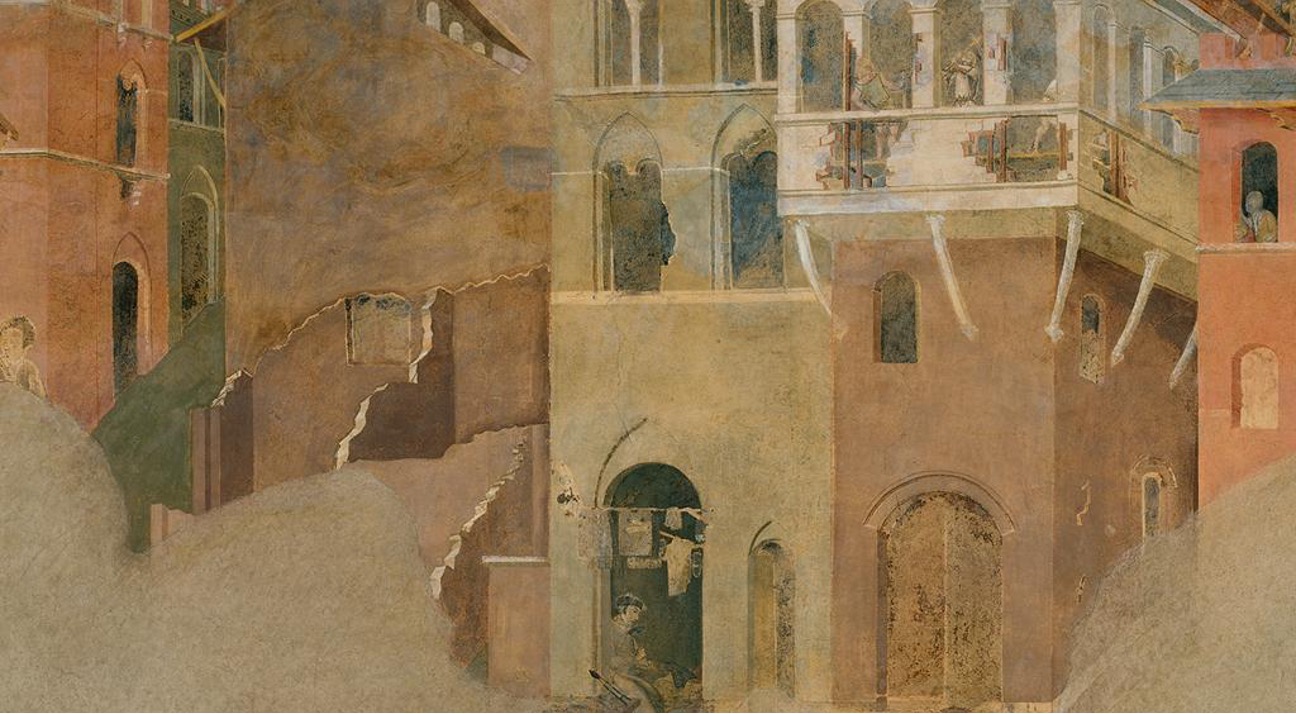
A city falling into disrepair
Where bodies lay askew on the hard ground

To my surprise almost no one was there
But an armourer working at his forge
And cruel guards who meant to threaten and scare.

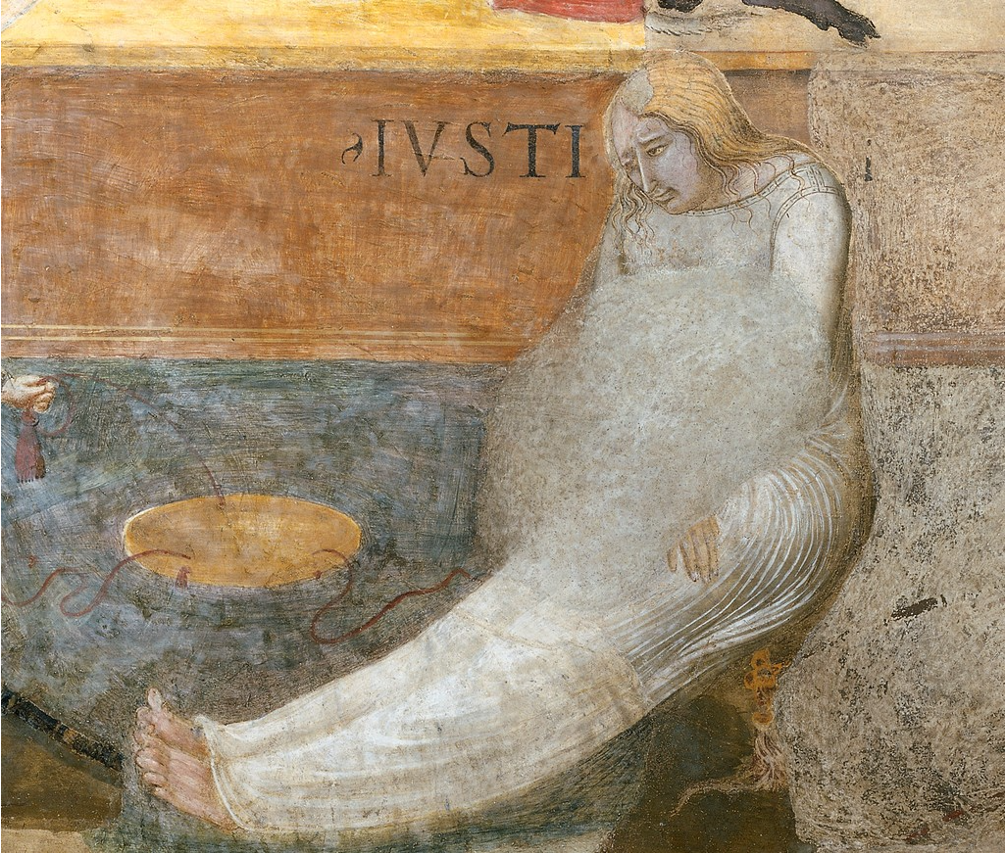
And there, I could not find Justice’s cord
Which, from her scales, is passed to Ben Comun
No, there I saw chaos and nothing more.

The wintry clouds blocked both the sun and moon
The paint was chipped, the ground strewn with debris
No dancers stepped gleefully to a tune.

From far above a man called out to me
So I might not be hit by falling rock
He hammered at the stone beneath his feet

So I, to him, said “Good sir, you must stop!”
He replied, “I have been assigned a task,
“These are not times of Prudence, though you mock.”

“But who is it who takes you for an ass?”
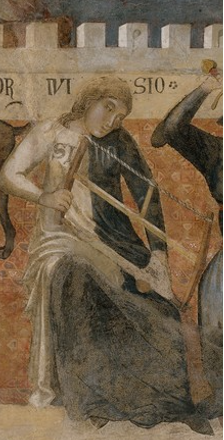
“She who wields the saw in Tyranny’s court!”
I did not know the way, and had to ask.

And so I set off in search of Discord
Along the way I ran into a clown
Against another’s throat he held a sword.

And there was still more violence in this town
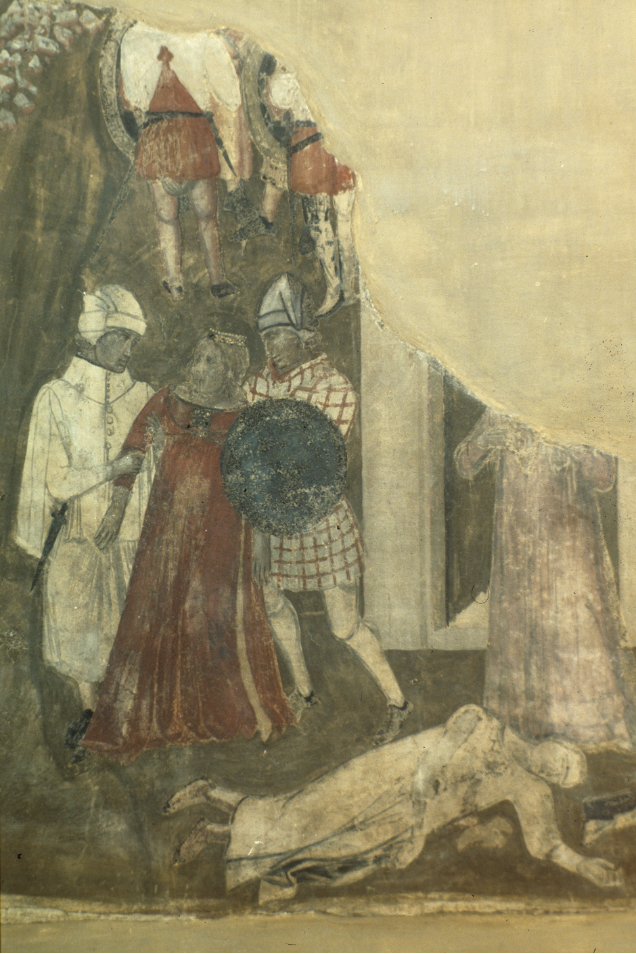
Two guards were dragging off an innocent,
A young woman in a striking red gown.

I walked, out to the countryside I went
Not far behind a figure named Timor
I watched, in awe, her terrible ascent.

With a wolfish face she began to soar
Bearing a banner, warning all of crime
And menacingly brandishing a sword.

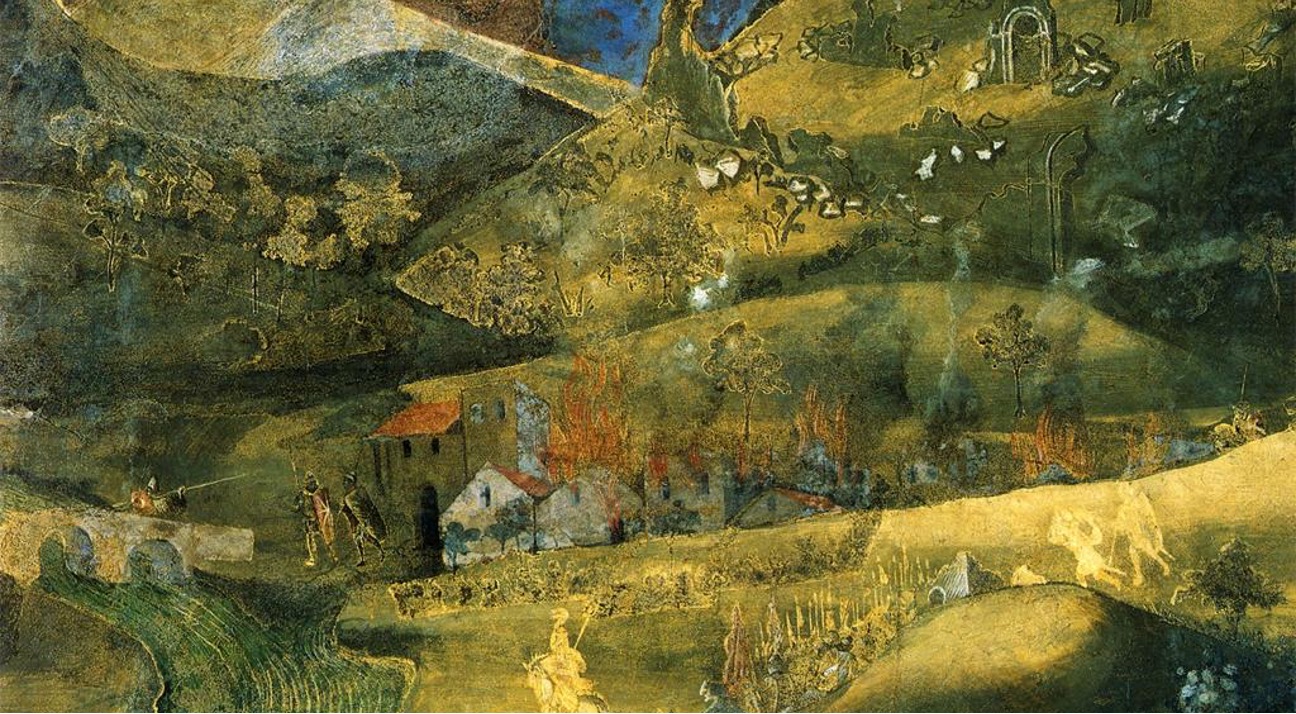
This was not an idyllic countryside
Where children play in green, abundant fields;
I saw and smelled the smoke of several fires.

When I arrived at Court, it was surreal
A horned ruler sat proudly on the throne
A goat called Lust sat meanly at her heel.

And these two Vices were far from alone
I saw Avarice, Pride, Cruelty, and Fraud
Frenzy, War, Discord, Vainglory, Treason.

But by far the saddest thing that I saw
Was good Justice, bound at Tyranny’s feet
Unable to enact her perfect law.
Justice, bound
Discord sawing herself in two
Timor flying over the countryside
A rural village in flames
Violence in the city
Siena in a state of disrepair
Class Connection
Lorenzetti’s Allegory and the Story of King Ahebi
Lorenzetti’s fresco exhibits a theme of self-destruction. Discord saws herself in half, and “at top centre, two men are demolishing the house they stand in” (Hyman 116). In colonial Nigeria, Ahebi Ugbabe used her power to lead the British conquerors to her hometown. In acting as an informant, she became an accessory to the brutal colonization of her homeland, lifting a saw to her own cultural identity and freedom. Ahebi exploited the discord she sowed to rise into a position of power, ultimately becoming a female king. Her rule, though legendary, approached tyranny: “Ahebi’s feet, it was rumored, never touched the ground” (Achebe 135).
Works Cited
Achebe, Nwando. The Female King of Colonial Nigeria: Ahebi Ugbabe, Indiana University Press, 2011.
Hyman, Timothy. Sienese Painting. Thames & Hudson, 2003.
Matar, Hisham. A Month in Siena. Random House, 2019.
