He was found by the Bureau of Statistics to be
One against whom there was no official complaint,
And all the reports on his conduct agree
That, in the modern sense of an old-fashioned word, he was a saint…
– W. H. Auden, “The Unknown Citizen”
If you are neutral in situations of injustice, you have chosen the side of the oppressor. If an elephant has its foot on the tail of a mouse, and you say that you are neutral, the mouse will not appreciate your neutrality.
– Archbishop Desmond Tutu
I suggest that you read this essay in a split-screen window with my Nontextual Something New: The Shape of Justice. Throughout the essay, I have linked other elements of my portfolio that are directly relevant to the text. Not every element is linked here, so I encourage you to explore my Portfolio independently of this page.
Justice As Action and Response
When I first learned that I would have to define justice for my 2025-2026 Humanities Portfolio, I thought of justice as a sort of utopia. In a perfect world, society would achieve justice. My initial approach, while understandable, limited me. I only began to make progress on my definition once I asked myself why justice would be perfect. I realized that justice was simply a means of achieving something greater, something objectively good. For, the word “justice” immediately calls to mind injustice. It implies that an injury has taken place, that some wrongdoing must be corrected. It was this realization that led me to my final definition of justice: taking action where it is called for, whether for yourself or on behalf of others. Justice is a means of restoring moral order to the world. It exists to fill an absence.
Once I realized that justice is a response to a moral aberration, I began to see every new concept through the lens of absence. Empty space carries just as much weight as anything of real substance does. Absences shape society, whether we can see them or not. In a commitment to nonideal theory, I chose to make “Absence” the theme of my Portfolio. I learned about nonideal theory from Charles W. Mills’s “‘Ideal Theory as Ideology.” Mills argues that we should work to attain ideals by first analyzing the world as it is, rather than how it could be if it were perfect. As I crafted my portfolio, I realized that I needed to understand justice from the perspective of the absences to which it responds.
This year, my Humanities class discussed the meaning of the term “hegemony.” According to the Merriam-Webster Dictionary, hegemony is “the social, cultural, ideological, or economic influence exerted by a dominant group” (“Hegemony”). My professors likened hegemony to the air we breathe, or water to a fish; hegemonies are all around us, and they are so prevalent that we often cannot recognize them as anything but normal. I argue that the absence of moral reckoning, or the empty space that justice seeks to fill, is its own broad hegemony. Previous injustices shape everything that we pursue in society today, even though we cannot see them.
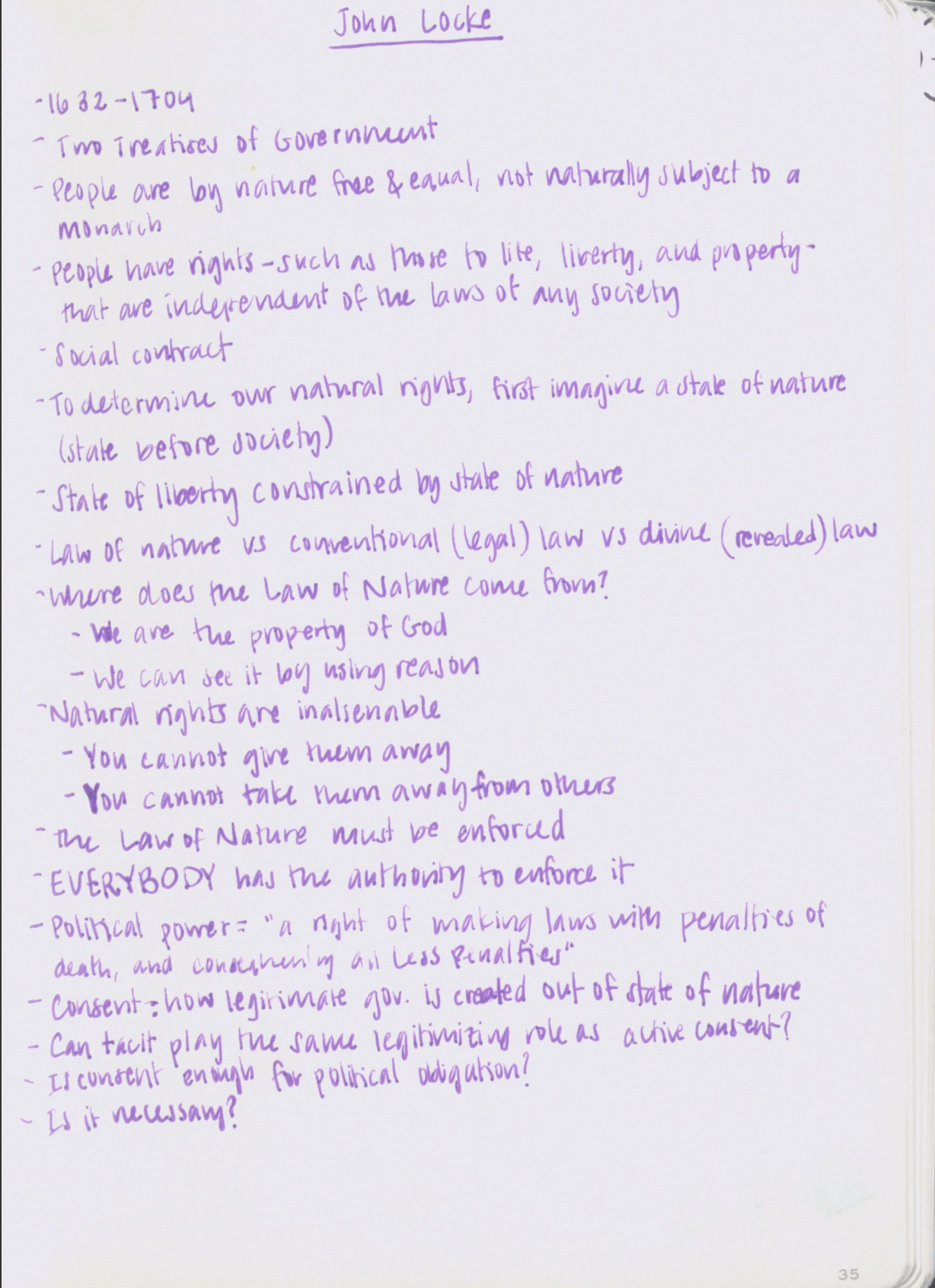
John Locke’s Second Treatise of Government forms the basis of my conception of moral order. Locke defined justice as adherence to an objective code of moral obligation called the law of nature. This law “teaches all mankind… that being all equal and independent, no one ought to harm another in his life, health, liberty, or possessions” (Locke). The law of nature is the closest relative of my own idea of moral alignment. Justice is a means of returning to a code of health, happiness, and independence.
Locke’s philosophy provides an initial clue as to what justice looks like. He explains that when people consent, by the social contract, to exit the state of nature, they expect their new government to uphold the law of nature on their behalf. In this way, it becomes the government’s responsibility to act for its citizens. Consequently, the social contract represents one approach to achieving correct action, or justice.
However, the law frequently fails to enact justice on behalf of its citizens. In Prigg v. Pennsylvania, the Supreme Court did not protect the rights of the formerly enslaved Margaret Morgan. Despite this, the Court succeeded in upholding Constitutional law. This case reveals that the action that closes the moral gap may not directly stem from the event that prompted it. In Prigg v. Pennsylvania, the next step lay outside the existing legal framework, as neither the plaintiff nor the defendant’s positions recognized Margaret Morgan’s human rights. Thus, the law cannot always designate correct action.
When the structure of society prevents correct action, it falls upon individuals to leave the current arrangement in order to pursue justice. “The Ones Who Walk Away from Omelas” depicts utopia at the price of one individual’s suffering. At the end of the short story, the people who choose to leave the city exemplify the first step on the path to justice: going in search of a social structure that allows citizens to uphold the moral law.
Those who do not pursue action not only allow, but partake in injustice. In the 1961 film Judgment at Nuremberg, a Nazi judge on trial admits that he was “worse than any of [the other judges] because he knew what they were, and he went along with them” (Judgment 2:25:20). When Hitler came to power, German judges should have taken action by leaving the courts. When a previously just structure becomes restrictive, it is up to individuals either to alter their current environment or to seek out a new one. If an individual does not act, he becomes an accessory to injustice, even though it is his surroundings and not he who has changed.
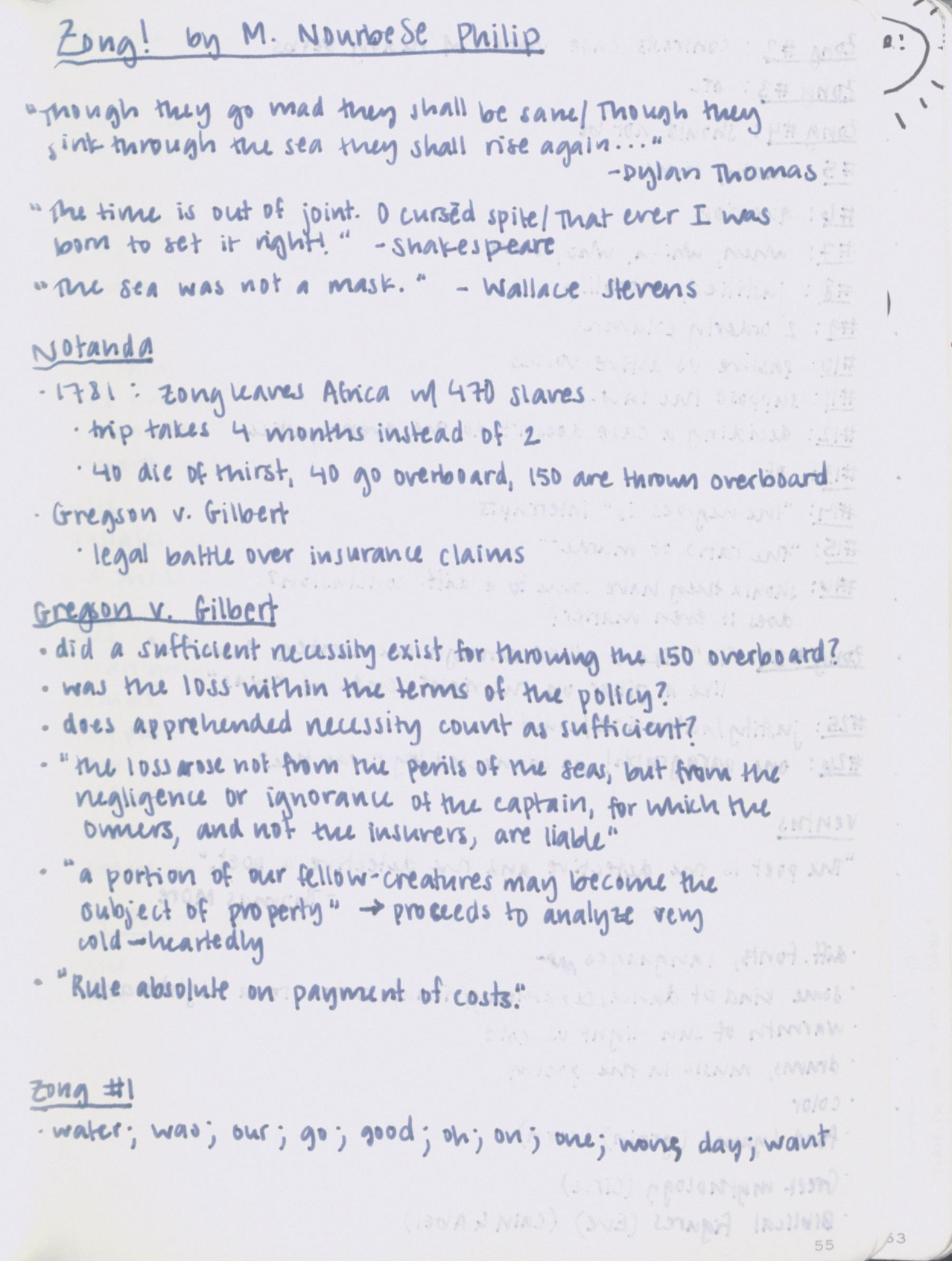
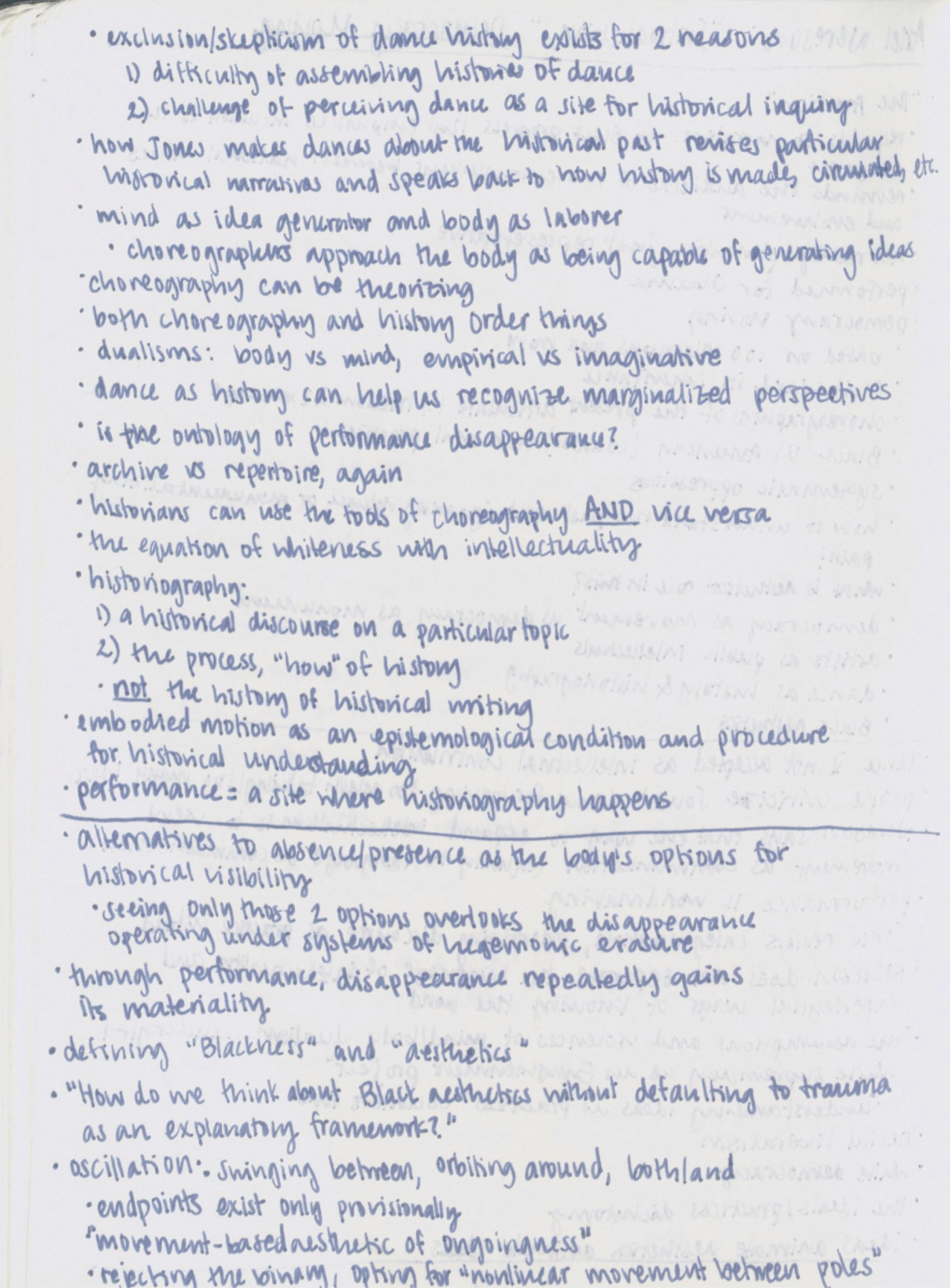
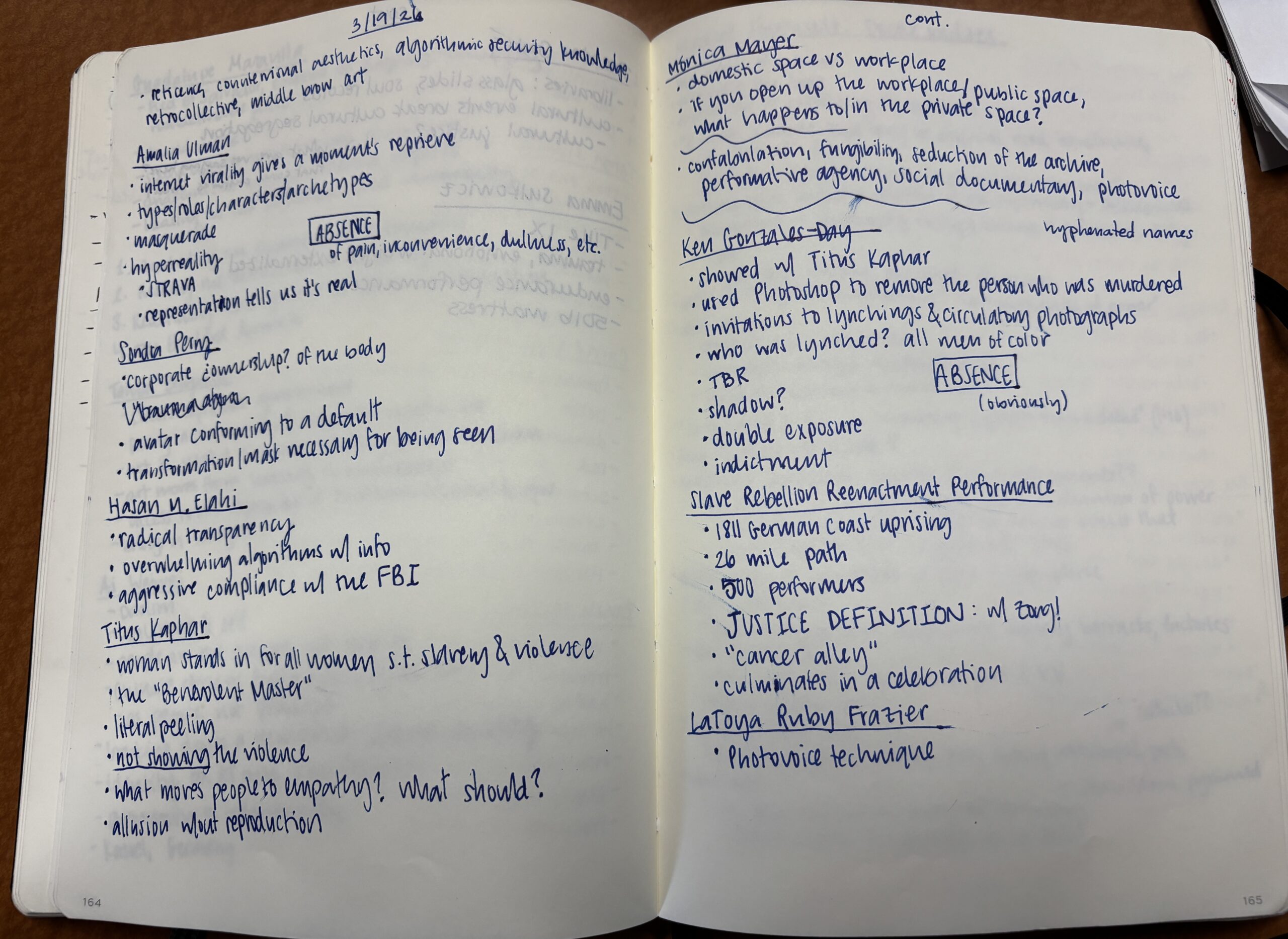
Creative pursuits can be a form of taking action. M. NourbeSe Philip responds to the suffocation of enslaved people aboard the Zong ship by giving the words in her poetry space to breathe. Current generations cannot go back in time and save the victims of the Zong massacre. However, work like Philip’s responds, in part, to the original call for action. Dance can be another form of correct action. By choreographing historical disappearances, artists such as Bill T. Jones represent marginalized groups such as Black Americans (Nereson 16). Therefore, correct action can be pursued long after a grievance calls for it, and art is an effective way of accomplishing this.
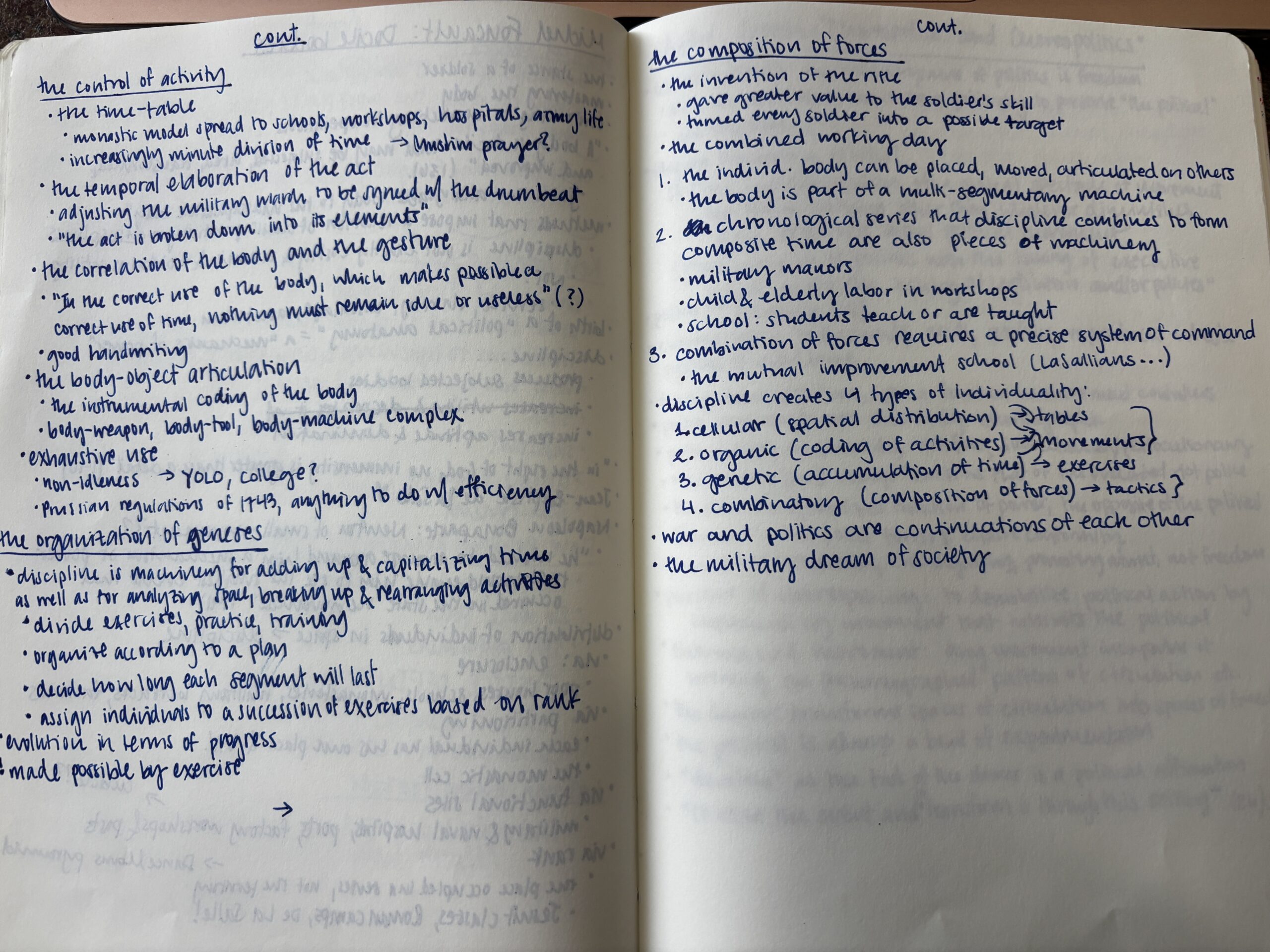
Sometimes an act of injustice moves toward and away from the moral code at the same time. Michel Foucault explains this phenomenon in detail in his book Discipline and Punish. According to Foucault, discipline subjects bodies to extreme methods of control while simultaneously increasing their utility. For example, John Baptist de la Salle founded the Institute of the Brothers of the Christian Schools to educate impoverished young boys, responding to a call for action. However, he accomplished this by imposing strict rules about handwriting, movement, and scheduling on his pupils. As La Salle’s mission moved him closer to the original moral code, his method moved him further away from it. Foucault’s study of discipline reveals that justice can only fill the moral gap if it is pursued in the correct manner.
When a person responds to an ethical deviation, she pursues justice. In order to completely enact justice, she must fully satisfy the call for a response; in other words, she must fully close the moral gap. More often than not, this requirement means that one individual cannot serve justice on her own.
Although I have not included this question in my stop-motion video, I wonder if justice can ever fully be achieved. Actions that come long after the initial call may be ultimately incapable of completely responding to injustice due to their timing, though they can make significant progress. If this is the case, then mankind has an asymptotic relationship to justice: we may approach it infinitely, constantly getting closer, but ultimately that last space between us and the line is lost to time.
Pages from My Notebook
Zong! by M. NourbeSe Philip (Excerpt)
Two Treatises of Government by John Locke
Democracy Moving by Ariel Nereson (Excerpt)
Discipline and Punish by Michel Foucault (Excerpt)
“‘Ideal Theory’ as Ideology” by Charles W. Mills
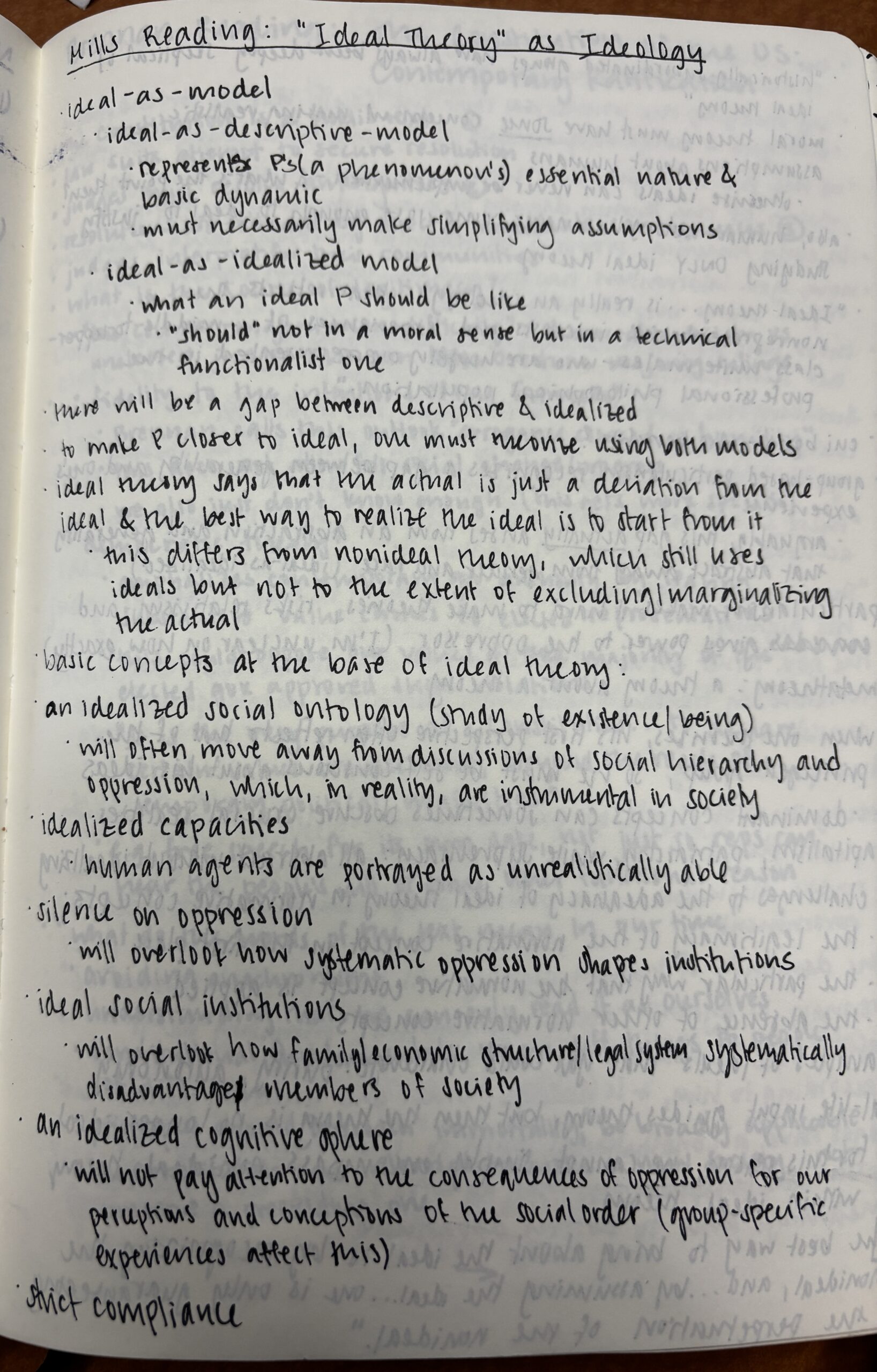
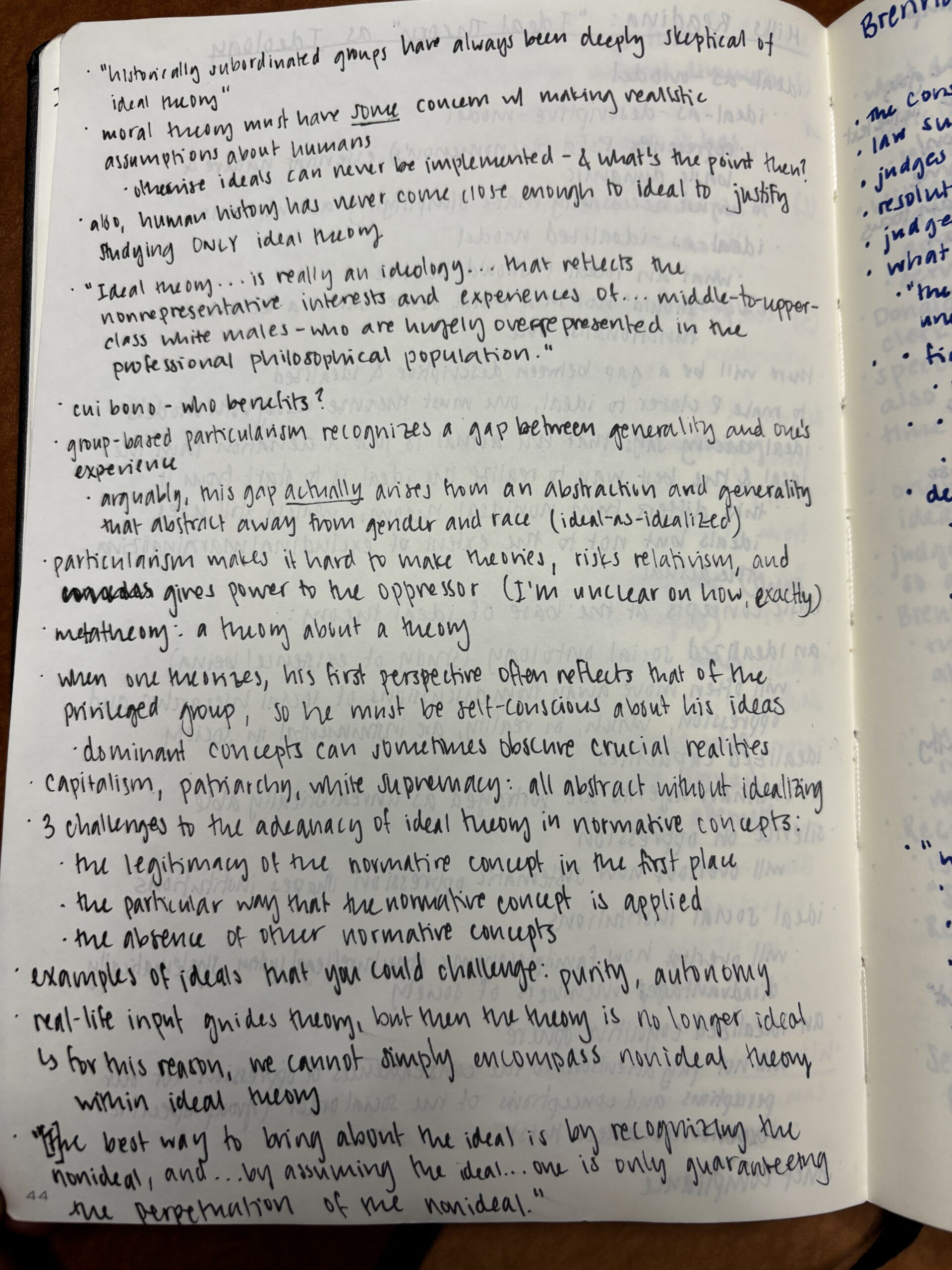
Class Notes
Works Cited
Edward Prigg, Plaintiff in Error, v. The Commonwealth of Pennsylvania, Defendant in Error. Supreme Court of the United States, 41 U.S. 539, 1842.
Foucault, Michel. Discipline and Punish: The Birth of the Prison. Vintage Books, 1977.
“Hegemony.” Merriam-Webster.com Dictionary, Merriam-Webster, https://www.merriam-webster.com/dictionary/hegemony.
Judgment at Nuremberg. Directed by Stanley Kramer, screenplay by Abby Mann, 1961.
Le Guin, Ursula K. “The Ones Who Walk Away from Omelas.” The Wind’s Twelve Quarters, HarperCollins, 1973.
Locke, John. “Second Treatise of Government.” The Project Gutenberg eBook of Second Treatise Of Government, by John Locke, 22 Apr. 2003, www.gutenberg.org/files/7370/7370-h/7370-h.htm?ref=americanpurpose.com.
Mills, Charles W. “‘Ideal Theory’ as Ideology.” Hypatia, vol. 20, no. 3, Summer 2005, pp.
165-184. JSTOR, https://www.jstor.org/stable/3811121.
Nereson, Ariel. “Introduction.” Democracy Moving : Bill T. Jones, Contemporary American Performance, and the Racial Past, University of Michigan Press, 2022, pp. 1–25.
Philip, M. NourbeSe. Zong! Wesleyan University Press, 2011.
