Introduction
Paulina’s Theme
Gerardo’s Theme
Context
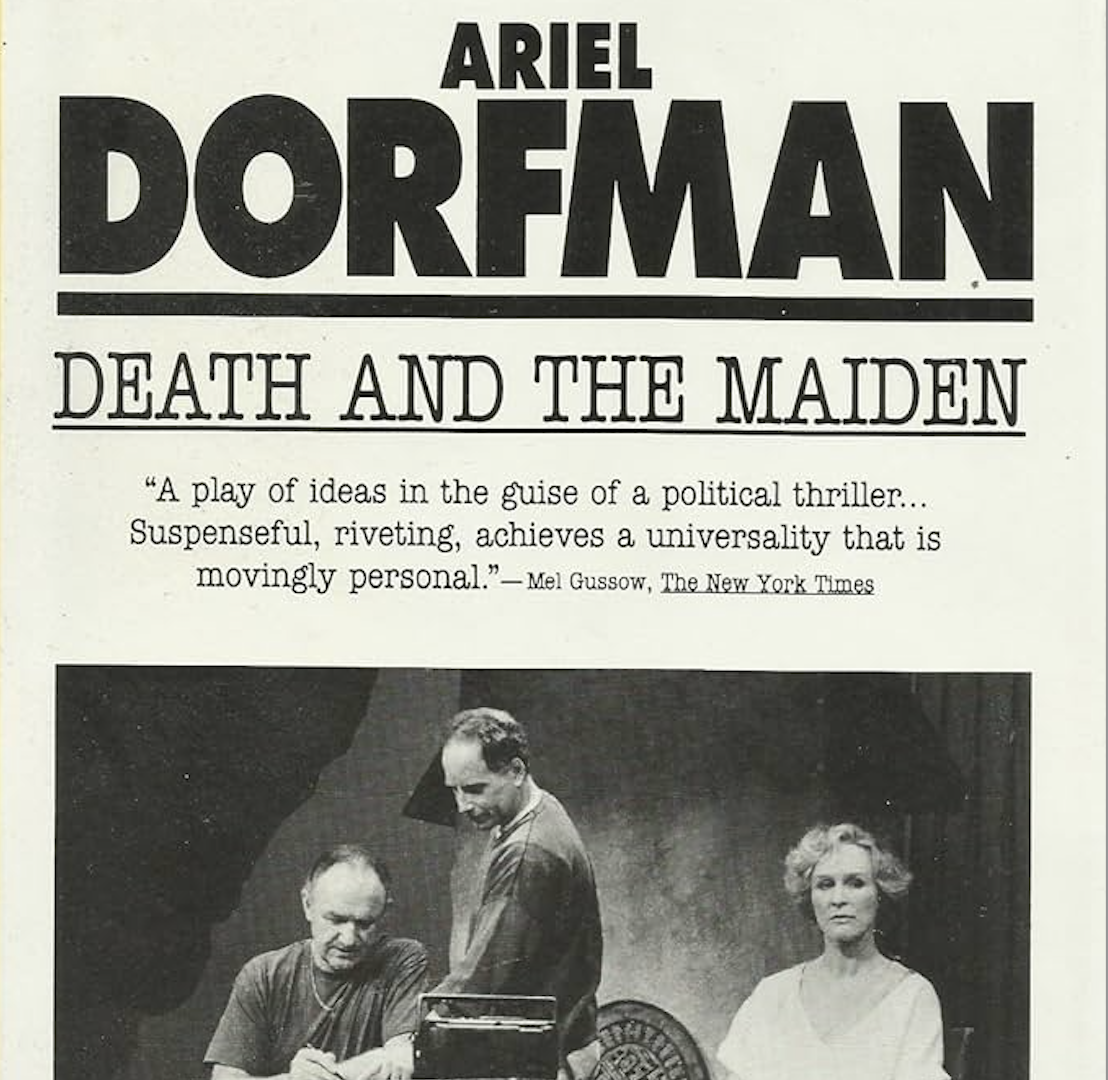
Ariel Dorfman’s 1990 play Death and the Maiden asks who gets to define justice. The setting is “a country that is probably Chile but could be any country that has given itself a democratic government just after a long period of dictatorship,” and the cast is made up of a modest three characters.
The first, Paulina Salas, was taken as a political prisoner and tortured some fifteen years before the present. Her husband, Gerardo Escobar, is set to participate in the National Commission for Truth and Reconciliation, in the country’s first steps toward a new democracy. The third character is Dr. Roberto Miranda, who happens upon Gerardo and Paulina’s home by chance, but is not unknown to Paulina. She is convinced that Roberto is her torturer and rapist.
The play’s name comes from Franz Schubert’s String Quartet No. 14 in D Minor, often called Death and the Maiden. The name refers to a musical passage in the piece’s second movement, an echo of a song that Schubert wrote in 1817. However, it is the first movement that begins to play in the last scene of Dorfman’s work.
In the first movement, there are two identifiable musical themes. The first is fast and anxious. It continues to build until the fiery motif from the introduction is repeated. After the music reaches this climax, it becomes sweet, gentle and reassuring. However, tense eighth notes underneath the melody remind the listener that this is no lullaby.
As a listener, the first theme reminds me of Paulina, angry and desperate to enact some sort of justice with the doctor at her disposal. The second theme evokes Gerardo, who repeatedly tries to reason with his wife in a way that is logical yet perhaps condescending or naive.
A different listener may very well have a different perspective on what each theme represents. Perhaps the themes are Paulina’s conflicting desires for revenge and closure. Maybe the second melody imitates the doctor’s plea of innocence. The music could also function as another reminder of the setting, a country fighting to keep violence and corruption at bay while laying new groundwork.
Here, I have recreated the introduction and each theme. While I was able to play and layer both violin parts, I was not able to record the viola or cello lines. The lower parts add rhythmic variation and tension to the piece. Without them, listeners might better concentrate on the main voice in each theme. I found that temporarily removing context can be valuable because it improves one’s understanding of the total product. Thus, I encourage you to listen to my version, then listen to a professional recording.
Class Connection
By assigning each character a theme, I was able to better experience their individual frustrations and desires. The immersion provided by the music was missing from my read-through of the script.
In Death and the Maiden, Paulina expresses her sense of helplessness as a woman and a living survivor. She asks Gerardo, “And why does it always have to be people like me who have to sacrifice, why are we always the ones who have to make concessions when something has to be conceded[?]” (Dorfman). The Chilean Commission “would [only] investigate the crimes of the dictatorship that had ended in death or its presumption” (Dorfman). Additionally, it had no power to prosecute the perpetrators of those crimes.
The battle between various musical themes in Schubert’s work reflects a battle between different conceptions of justice. Dorfman retains ambiguity around whether Paulina kills Roberto in the name of justice or lets him go free in an entirely different name for the same thing. However, her historical position does not seem favorable.
Works Cited
Dorfman, Ariel. Death and the Maiden, Nick Hern Books, 1996.
Wikipedia contributors. “String Quartet No. 14 (Schubert).” Wikipedia, The Free Encyclopedia. Wikipedia, The Free Encyclopedia, 30 Oct. 2025. Web. 10 Dec. 2025.
