Democracy Moving, Disappearance, and the Fluidity of History
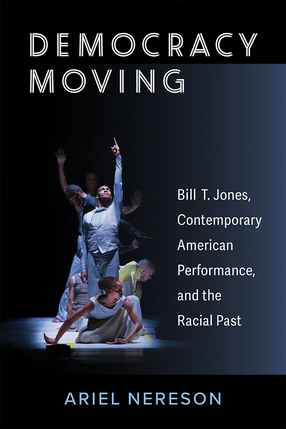
In Democracy Moving, Ariel Nereson explores dance’s ability to function as both history and historiography. She does this by analyzing three dance works by Bill T. Jones and their representation of the Black US American experience. In her introduction to the book, Nereson explains that dance as historiography has the ability to chronicle historical disappearances: “[W]e find…alternatives to absence or presence as the body’s options for historical visibility, [namely] the fugitive disappearance that operates alongside or underneath systems of hegemonic erasure” (Nereson 15). It is easy to think of history as a record of what was and what was not. However, it is both possible and crucial to adopt a more inclusive view of history, one that acknowledges how dominant groups have stamped out minorities’ cultural practices—as well as larger, more obvious entities like actual people and places. In reading about disappearance, I was reminded of how Nazi lawyers initiated the disappearance of Jewish Germans by demoting them from citizens to nationals (Mamdani 106). Popular historiography would contrast the presence and subsequent absence of Jewish people’s rights. Historiography as Nereson and other dance scholars would have it instead asks us to analyze the actual process by which those rights were removed. Nereson’s focus on movement, both physical and metaphorical, allows history to better reflect real life. We are reminded that history is made up not of bullet points and T-charts, but of the constant flow of people through time.
Works Cited
Mamdani, Mahmood. “Nuremberg: The Failure of Denazification.” Neither Settler nor Native: The Making and Unmaking of Permanent Minorities, The Belknap Press of Harvard University Press, 2020, pp. 105–120.
Nereson, Ariel. “Introduction.” Democracy Moving : Bill T. Jones, Contemporary American Performance, and the Racial Past, University of Michigan Press, 2022, pp. 1–25.
