John Locke, Peter Singer, and the Oxygen Mask Rule
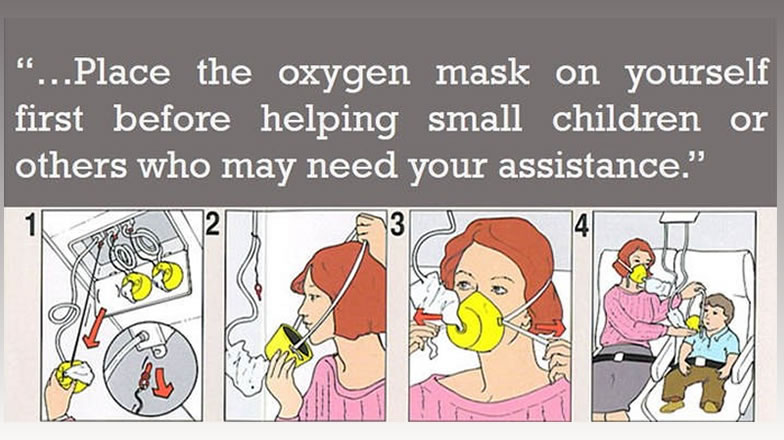
In Locke’s Second Treatise of Government, he asserts that “Every one…when his own preservation comes not in competition, ought he, as much as he can, to preserve the rest of mankind” (Locke). This principle seems simple enough; we hear it every time we fly on an airplane. When we are told to “help ourselves before helping others,” whether by Enlightenment philosophers, flight attendants, or simply our biology, it may leave us wondering when exactly to cross the line between ourselves and others. Peter Singer attempts to distinguish these two responsibilities in his 1972 paper “Famine, Affluence, and Morality.” Not unlike Locke, he thinks that one “ought to give as much as possible, that is, at least up to the point at which by giving more one would begin to cause serious suffering for oneself and one’s dependents” (Singer 234). Singer’s language here is extremely similar to Locke’s. By elaborating on an older principle, Singer gives us insight into what Locke might have meant by his original statement. In the 20th century, Locke’s “preserv[ing] the rest of mankind” becomes “giving.” Singer claims that humanity’s goal is not simply to save lives but to alleviate poor standards of living by whatever means available. Perhaps recent globalization and the establishment of charitable infrastructures enable Singer to make this clarification. Additionally, Singer explains that one should prioritize himself only when he begins to experience “serious suffering.” This specification, like the one before it, seems to increase the moral burden on humanity’s shoulders. In 1689, Locke introduced the world to ideas that now shape every aspect of contemporary nations, from their governments to their airplanes. In his wake, we are left to question whether the descendants of those ideas ultimately lead us toward or away from the sentiment originally behind each principle.
Works Cited
Locke, John. “Second Treatise of Government.” The Project Gutenberg eBook of Second Treatise
Of Government, by John Locke, 22 Apr. 2003, www.gutenberg.org/files/7370/7370-h/7370-h.htm?ref=americanpurpose.com.
Singer, Peter. “Famine, Affluence, and Morality.” Wiley, JSTOR, 1972, Accessed 16 Oct. 2017.
