Indifference in Inferno, Sin of…?
To this day, Dante Alighieri’s Divine Comedy is responsible for much of the popular mythology surrounding the Christian afterlife. When Alighieri’s two main travelers cross the threshold of Hell, they find themselves in an intermediate space that precedes the first circle. There, Virgil and Dante the pilgrim meet those who won “neither praise nor blame for the lives they’d led,” as well as the “angels who stood aside, who neither hastened to their Lord’s defense nor rose against him in rebellious pride” (citation 29). Just as these souls stood between causes during their lifetimes, they now find themselves in neither Heaven nor Hell. This is one aspect of the contrapasso they experience. Though the souls are not technically in Hell, they still experience suffering. It follows that Dante disapproves of indifference and, above all, inaction. However, it seems that he considers it unjust to actually designate a circle for the bystanders of the world. Throughout our study of justice, I have carefully considered the moral consequences of failing to stand for a cause. Dante’s take on inaction—wrong, but not overwhelmingly so—more strongly appeals to me than does a rigid Singerian view of moral duty.
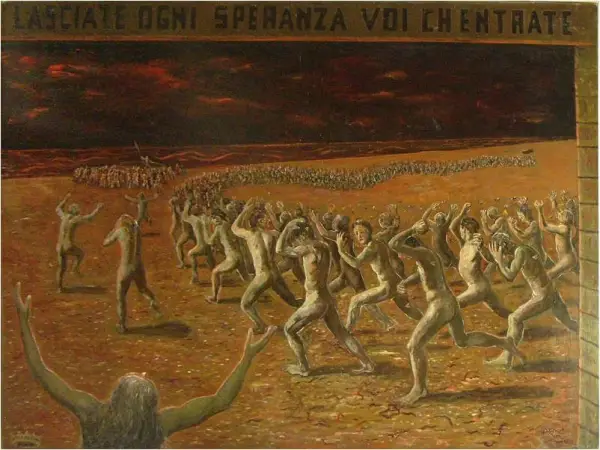
The Vestibule of Hell, https://infernobydante.wordpress.com/2013/09/25/canto-iii/
Works Cited
Alighieri, Dante. Inferno: A New Verse Translation by Michael Palma. Translated by Michael
Palma, W. W. Norton & Company, 2003.
